




PBT Series
PBT plastics are a class of plastics consisting of polybutylene terephthalate as the main body. Polybutylene terephthalate (PBT) is a polymer of polybutylene terephthalate and 1,4-butanediol. Abbreviated as PBT, it is a polycondensation of terephthalic acid and 1,4-butanediol.Together with PET, PBT is known as a thermoplastic polyester.
Affiliated Classification:
PBT
Key words:
Wangpin
Product Description
PBT Series/Polybutylene terephthalate
PBT plastics are plastics composed of polybutylene terephthalate as the main body.
Polybutylene terephthalate (PBT), also known as tetramethylene terephthalate, is a plastic made of polybutylene terephthalate (PBT), which is a combination of terephthalic acid and tetramethylene terephthalate. Abbreviated as PBT, it is a polycondensation of terephthalic acid and 1,4-butanediol.PBT and PET together are known as thermoplastic polyesters.
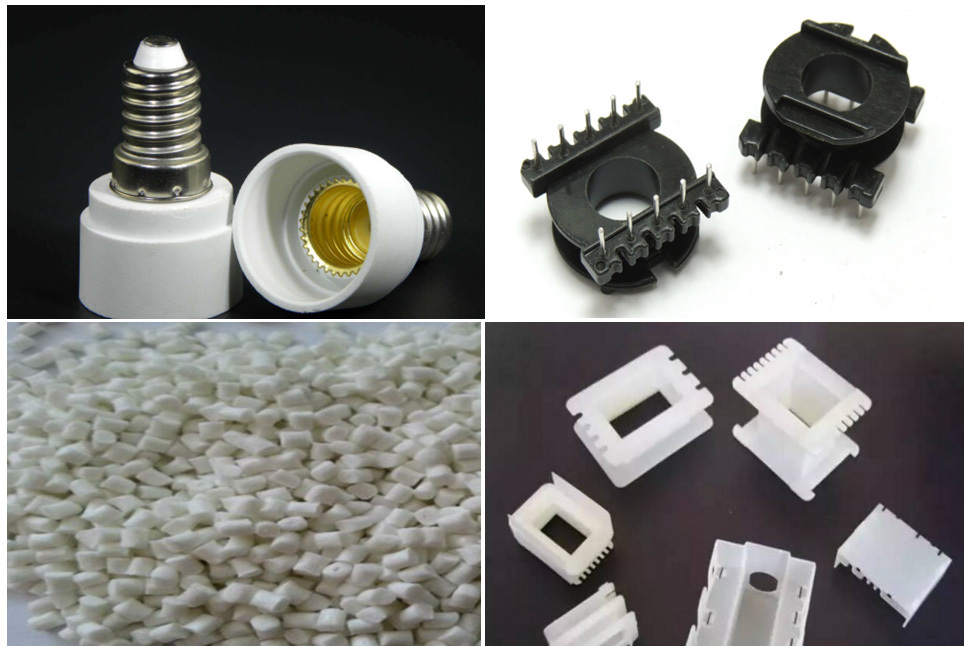
The scope of application of PBT modified materials developed and produced by our company:
1, electronic and electrical appliances: no fuse disconnectors, electromagnetic switches, chi return transformer, appliance handles, connectors, shells;
2, automobile: door handle, bumper, distributor plate cover, fender, wire guard shell, wheel cover;
3, Industrial parts: OA fan, keypad, fishing reel, parts, lampshade.
Material application cases:
PBT Properties(DATA SHEET)
| Thermal properties | Standard | Unit | W1815UV 15%glass-fiber reinforced | W1820 20%glass-fiber reinforced | W1830 30%glass-fiber reinforced | W1820TU (LEDcategorical) |
| Heat distortion temperature | GB/T 1634.1-2004 | ℃(1.80 MPa) | 195 | 205 | 208 | 205 |
| Mechanical properties | Standard | Unit | Value | Value | Value | Value |
| Notched impact strength | GB/T 1843-2008 | KJ/m2 | 6.5 | 8 | 6.5 | 4 |
| Tensile strength | GB/T 1040.2-2006 | MPa | 95 | 74 | 110 | 100 |
| Elongation at break | GB/T 1040.2-2006 | % | 3.5 | 4 | 2.5 | 3 |
| Flexural modulus | GB/T 9341-2008 | Mpa | 4500 | 5000 | 6000 | 5000 |
| Flexural strength | GB/T 9341-2008 | Mpa | 130 | 120 | 140 | 130 |
| Rockwell hardness | GB/T 9341-2008 | R | 118 | 118 | 119 | 118 |
| Rheological properties | Standard | Unit | Value | Value | Value | Value |
| Molding shrinkage (across flow) | GB/T 9341-2008 | % | -- | -- | -- | -- |
| Molding shrinkage (flow) | GB/T 9341-2008 | % | 0.1-0.5 | 0.1-0.5 | 0.1-0.5 | 0.1-0.5 |
| Melt flow rate | GB/T 9341-2008 | g/10min | 12 | 14 | 14 | 12 |
| Electrical properties | Standard | Unit | Value | Value | Value | Value |
| Volume resistivity | IEC 62631-3 | Ω.cm | ≥1015 | ≥1015 | ≥1015 | ≥1015 |
| Surface resistivity | IEC 62631-3 | Ω | ≥1013 | ≥1013 | ≥1013 | ≥1013 |
| Dielectric strength | IEC 60243-1 | KV/mm | 20 | 20 | 20 | 20 |
| Comparative tracking index | IEC 60112 | V | -- | -- | -- | -- |
| Flammability properties | Standard | Unit | Value | Value | Value | Value |
| GWFI /Glow-wire flammability index | IEC 60695-2 | ℃ | 960 | 960 | 960 | 960 |
| GWIT /Glow-wire ignition temperature | IEC 60695-2 | ℃ | -- | -- | -- | -- |
| Flammability | UL 94 | - | V0 | V0 | V0 | V0 |
| Other properties | Standard | Unit | Value | Value | Value | Value |
| Density | GB/T 1033.1-2008 | g/cm3 | 1.53 | 1.58 | 1.62 | 1.60 |
| Water absorption(24h) | GB/T5486.3—2001 | % | 0.03 | 0.03 | 0.03 | 0.03 |
| Referenceprocessing condition | Value | Value | Value | Value | ||
| Drying | -- | -- | 115-120℃/4-6H | 115-120℃/4-6H | 115-120℃/4-6H | 115-120℃/4-6H |
| Mold temperature | -- | -- | 80-110℃ | 80-110℃ | 80-110℃ | 80-110℃ |
| Recommended processing temperature | -- | -- | 230-260℃ | 230-260℃ | 230-260℃ | 230-260℃ |
| Product Characteristics and Application | Excellent chemical resistance, electrical properties, good weather resistance. Applied to various parts of electronic and electrical appliances | Excellent processability, electrical properties, fatigue resistance, heat resistance. Used in electronic and electrical housings | Excellent dimensional stability, heat resistance, fatigue resistance. Used in all kinds of electronic and electrical housings | Thermal conductivity, light shielding, high dimensional stability, used in LED energy-saving lamp head products | ||
Unless otherwise specified, the above data refers to Dry Application Models (DAM) measured at a relative humidity (RH) = 50% and at 23°C in a laboratory environment. The above data are typical values for reference only and are not guaranteed.
The data above was measured under the laboratory environment of 23℃ and RH=50% for DAM status unless otherwise stated , all is typical data, only for reference, not the permit of quality assurance
Related Products
Message